

made for life with God in community
Monday, December 12, 2011
An Observation on Prophets


Tuesday, November 29, 2011
Forgiving and Forgetting
Hebrews 10:15-18:
"And the Holy Spirit also testifies to us; for after saying,
'This is the covenant that I will make with them
after those days, says the Lord:
I will put my laws upon their heart,
and on their mind I will write them,' (Jeremiah 31:33)
after those days, says the Lord:
I will put my laws upon their heart,
and on their mind I will write them,' (Jeremiah 31:33)
He then says,
Now where there is forgiveness of these things, there is no longer any offering for sin."
Too many times we contrast forgiving and forgetting, do we not, as if God exhorts us to forgive while not expecting us to forget. I find it blessedly intriguing that His own model of forgiveness is not such.
Wednesday, November 16, 2011
Limiting Speech
I am a talker. I actually have a small level of what I would go so far as to call anxiety when I fear not getting out of my mouth the finished product of what is in my head in conversation. But it hit me today that there are crucial moments, such as when a surgeon yells out a life-saving instruction, when a military leader says "go" or "fire," or when a parent yells "STOP!" to a child walking obliviously into the trajectory of an oncoming vehicle. In fact, there are crucial hours, a whole series of moments such as an entire surgery or the hours Houston spends communicating to astronauts during a crisis oriented shuttle mission. During these crucial moments brave people give up sleep, emotional impulses, and instinctive preferences in order to keep going in a life-saving or even world-changing way.
But this is not my normal daily experience. Many times throughout my day I desire to operate beyond limitations - some natural and some that should be self-imposed - in order to waste energy and words on what is not a crucial moment.
But this is not my normal daily experience. Many times throughout my day I desire to operate beyond limitations - some natural and some that should be self-imposed - in order to waste energy and words on what is not a crucial moment.
Wednesday, November 9, 2011
The Missionary Power of Prayer

@E_StanleyJones "Prayer is commission. Out of the quietness with God, power is generated that turns the spiritual machinery of the world."
As a missionary of the gospel of Jesus, Jones had a clear understanding that the activity of God in the world flowed out the nature of God being in mission to save the world. Thus, the life of the child of God and disciple of Jesus is to flow out of union with this missionary God. So, as Jones states, prayer becomes commission. Communing with God leads to being commissioned by God. As we dwell in the presence of God seeking His heart, His mind, and His will, we end up encountering the One who is redeeming us and those around us and relentlessly pursuing the lost sheep (Matthew 18:12-14). And out of this quiet dwelling in God and with God, we yield ourselves to the power of His Spirit to move through and among us in such a way that "the spiritual machinery of the world" is turned. Hallelujah! Prayer leads to action - both by God and ourselves.
I am challenged by the words of this missionary saint that we have but one thing to do in order to shake the spiritual realm with the power of the divine Creator and Savior of the world - pray. And out of this seemingly passive action, all other actions of eternal consequence find their purpose and motivation.
Let us pray.
Monday, October 24, 2011
What do you think of Paul?
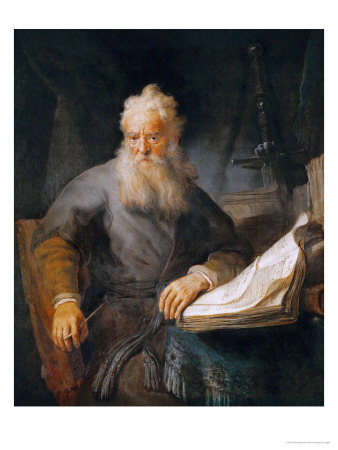
I did not like Paul. It seemed like everyone at my Southern Baptist college was obsessed with him, and I just didn't get it. It wasn't that I didn't think his writing was true. But when I read the stories of his life and his letters I could never feel completely comfortable with the tone. It seemed I must not understand his time, context, and the acceptable "posture" of the way he spoke and wrote. He seemed arrogant. He seemed proud. He seemed adamant about things that seemed to me more about personal preference (such as the conviction that one should avoid marriage if possible).
I just finished reading the book of Acts, not for the first time. And I can honestly say that, now, Paul is one of the figures in Christian history I admire most. His testimony, his conviction, his focus on the mission of God revealed in Christ, and the character traits he evidenced through his life and ministry strengthen my faith and challenge me to a life of more purity, fervor, passion, and commitment. He is a disciple of Jesus who I think I can sometimes misread or under-appreciate.
What are some things you admire about Paul? What are some things that turn you off or rub you the wrong way as you read about his life in Acts and his own letters in the New Testament? Please feel free to comment on this post and offer your response.
Saturday, September 24, 2011
Pluralism illustrated... What Oreos and North American religion have in common

There just isn't any other cookie that could be mistaken for an Oreo. An Oreo is still a cookie; it has the properties of a cookie and can be defined as a cookie by its characteristics. But the Oreo used to stand out. (In fact, it is still claiming to be Milk's favorite.) But if the cookie aisle were to continue on the trajectory it is on, it would eventually become the Oreo aisle. The variety of this one beloved kind of cookie is exploding! And all the sudden, the parameters for what defines an Oreo are being held loosely, they are expanding, some are falling away completely to add more variety for the consumer's customization, pallet, and personal preference. Let us have as many versions of one thing as we possibly can so that we can all live in "peace" and be "ok" as we satisfy our own egocentric view of what the best Oreo should be as if it wasn't Oreo that originally defined itself. [Peace is not, it seems, being unmistakably sure of the identity of the Oreo and knowing confidently whether one wants an Oreo or not.] This is pluralism. And when it comes to cookies, I'm not saying this is bad. I would be a hypocrite to say so, in fact. But this is telling of how our cultural mindset is changing. And it is good to be aware of as Christians engage in religious dialogue (in the broad sense...or "cookie" level) with others.
P.S. If there was only one other variety of Oreo besides the original, I would want it to be Double Stuff. This is a spiritual parallel in itself.
Closing Note: As I begin to blog again (hopefully more regularly and fruitfully for a change), I am not seeking to make definitive statements in hopes of impressing people or conform readers to my way of thinking as if Abingdon can't wait to get a hold of my ideas and print them in mass. Now that I am a pastor of a church, I recognize why newsletter articles were actually once very valuable to people and are to some still. This blog will go beyond that. My hopes are that I can say things that trigger thoughts perhaps someone has not had as they walk the road of their Christian faith and that I can begin conversations that others can pick up and offer reflections that help further growth. So feel free to offer a different perspective, a corrective, questions, or comments of any kind.
Grace and peace,
Jonathan
Thursday, September 22, 2011

Subscribe to:
Posts (Atom)